


The Complete Pilates Glossary
Updated: Sep 29
Every term, cue, and piece of kit you’ll encounter in class - explained in plain English.

Feeling slightly lost in your first Pilates class? Wondering what a ‘Powerhouse’ is, or why your instructor keeps talking about ‘imprinting’ like it’s some kind of forensic investigation? You’re not alone - and you’ve come to the right place.
Pilates has its own language. Some of it is anatomical, some of it is movement-based, some of it is poetic imagery designed to help your body find a position it’s never been cued into before. All of it is useful once you know what it means.
This glossary covers the essential vocabulary of both Mat and Reformer Pilates, a full guide to the equipment you’ll encounter, the core principles of the method, and the difference between Classical and Contemporary Pilates.
Bookmark it, come back to it, and watch the language of Pilates start to feel less like a foreign tongue and more like something your body already understands.
What Is Pilates?
Pilates is a mindful, full-body movement method developed by Joseph Pilates in the early 20th century. It blends strength, flexibility, postural alignment, and controlled breath into a practice that works the body from the inside out - building core stability, spinal mobility, and muscular precision rather than surface-level bulk.
Joseph Pilates originally called his method Contrology - ‘the complete coordination of body, mind, and spirit.’ Today it’s practised globally by dancers, athletes, rehabilitation patients, and people who simply want to move better and feel stronger in their daily lives.
At Rise, we work across both Mat and Reformer (and apparatus, including the Wunda Chair and Half Barrel), and our instructors are trained to a high standard in both. Whether you’re brand new or deepening an existing practice, understanding the language of the method makes every session more effective.
A-Z: Glossary of Common Pilates Terms and Cues
Want to follow your instructor’s cues like a pro? These are the words and phrases you’ll hear most often in class. Some are anatomical, some are movement cues, some are pure Pilates tradition.
Abduction: Movement of a limb away from the midline of the body - think arms lifting out to a T-shape, or legs sliding apart. Comes up frequently in leg spring work and side-lying exercises.
Adduction: Movement toward the body’s midline - bringing the arms back in, or squeezing the legs together. A useful memory trick: you’re ‘adding’ the limb back toward centre.
Alignment: The ideal positioning of the head, spine, pelvis, and limbs relative to each other - designed to reduce unnecessary strain and maximise mechanical efficiency throughout movement.
Anterior: The front of the body. Your chest, abdomen, and thighs are all on the anterior side. Opposite of posterior.
Articulation: The sequential, vertebra-by-vertebra movement of the spine - rolling up or down one segment at a time rather than as a single unit. Seen clearly in the Roll Up, Spine Curls, and Bridge variations. Articulation is one of the most distinctive qualities of Pilates movement and a key marker of spinal health.
Balance: Your body’s ability to stay stable, often challenged through core work or single-leg movements.
Box (Body): An imaginary rectangle formed by the shoulders and hips. ‘Keep your box level’ means keeping these four points aligned and square - not tilted, not rotated. Essential for maintaining good form in exercises that challenge rotation or lateral stability.
Box (Equipment): A physical prop used on the Reformer. The Long Box lies lengthwise along the carriage for prone or supine exercises; the Short Box sits crosswise for seated spinal work. Both appear regularly in Reformer repertoire.
Breathing
A foundational principle of the method, not an afterthought. Pilates uses several breathing approaches depending on context:
Lateral Breathing: expanding the ribcage outward and back - not up toward the shoulders. Maintains core engagement while allowing full breath.
Diaphragmatic Breathing: deep breathing that engages the diaphragm and allows the belly to rise. Used in more restorative or awareness-based work.
Post-Lateral Breathing: directing breath specifically toward the back and sides of the ribcage, often used in exercises requiring strong anterior core engagement.
C-Curve: The rounded, C-shaped position of the spine in forward flexion - imagine your spine curving like the letter C, with the core engaged to create that shape from within rather than slumping passively. Fundamental to many abdominal and seated exercises.
Centering: The principle of initiating all movement from your ‘Powerhouse’ - the deep core of the body encompassing the abdominals, low back muscles, and pelvic floor. Centring isn’t just about abs: it’s about finding your physical and energetic centre before you move anything else.
Control: Pilates was originally called Contrology for a reason. Every movement should be precise, deliberate, and driven by muscular intention - never rushed, never momentum-led. Control is what separates Pilates from general exercise.
Core Strength: The strength of the deep stabilising muscles of the trunk: the transverse abdominis, multifidus, diaphragm, and pelvic floor. These work together as an internal corset that supports the spine and drives efficient movement.
Corset: A common imagery cue - imagine hugging your deep abdominal muscles in and up, like fastening a corset from the inside. Engages the Powerhouse without gripping the surface muscles or holding the breath.
Dorsiflexion: Flexing the foot - pulling the toes toward the shin. The opposite of plantar flexion (pointing). Your instructor may cue ‘flex’ rather than the technical term.
Extension: Straightening or lengthening a joint, or extending the spine into a backbend. Seen in exercises like Swan, Swimming, and any cobra-like position.
Flexion: Bending a joint, or rounding the spine into forward curl. The opposite of extension. The Roll Up, Single Leg Stretch, and Double Leg Stretch are all flexion-based exercises.
Flow: One of the six classical Pilates principles. Movement in Pilates should be seamless, continuous, and connected - not choppy or effortful. Joseph Pilates described the ideal practice as a moving meditation. Flow is what gives Pilates its distinctive quality of looking graceful even when it’s deeply challenging.
Hyperextension: When a joint moves beyond its healthy, natural range - the elbow locking back, the knee snapping straight. Pilates encourages full extension, but not to the point of strain or joint compression. Your instructor will cue ‘soft’ elbows or knees to prevent this.
Imprint / Imprinting: Gently flattening the lumbar spine (lower back) into the mat by engaging the abdominals and allowing the pelvis to tilt slightly posteriorly. Not a forced movement - more of a subtle settling. Used in supine exercises to protect the spine and establish core connection before loading.
Inner Eye: A poetic cue used to encourage internal body awareness - the practice of noticing your own alignment, sensation, and movement quality from the inside rather than relying on external mirrors or comparison.
Lateral: Toward the side of the body. Lateral flexion is a sideways bend of the spine. Lateral breathing expands the ribcage sideways. You’ll also hear it in the context of lateral movements of the limbs.
Midline: An imaginary vertical line running down the centre of the body from head to foot. Many exercises emphasise drawing the legs toward the midline, or maintaining symmetry on either side of it.
Navel to Spine: One of the most common Pilates cues. Means to draw the belly button gently inward and back toward the spine - engaging the deep transverse abdominis without gripping or sucking in the surface muscles. The engagement should feel like a subtle hollowing, not a bracing.
Neutral Pelvis: The pelvis is level - the hip bones (ASIS) and pubic bone are all in the same horizontal plane. Neither tucked under nor arched forward. Supporting a neutral pelvis helps maintain the natural curves of the spine.
Neutral Spine: The spine in its natural, unstressed position - with the gentle S-curve intact. Not flattened (imprinted) and not over-arched. Many exercises begin and end in neutral spine, though some intentionally move away from it.
Opposition: The principle of lengthening in two directions simultaneously - reaching the arms forward while extending the legs back, or growing tall through the crown of the head while grounding down through the sit bones. Opposition creates length, space, and energy in the body.
Pelvic Tuck: Drawing the tailbone under and engaging the lower abdominals to flatten the lumbar spine. Used to initiate flexion-based movements or to protect the lower back in certain positions. Distinct from neutral pelvis: a tuck deliberately takes the spine out of neutral.
Pilates Stance / Pilates V: A specific foot and leg position - heels together, toes apart at approximately 45 degrees, with the legs gently externally rotated from the hips. Engages the inner thighs and glutes and is the default lower body position in many classical exercises.
Plantar Flexion: Pointing the toes. The foot and ankle extend. The opposite of dorsiflexion. Used constantly in footwork and leg exercises on the Reformer.
Posterior: The back of the body - spine, glutes, hamstrings, calves. Opposite of anterior.
Powerhouse: The term Joseph Pilates used for the centre of the body’s strength: the abdominals, lower back, hips, and pelvic floor - roughly the area from the lower ribs to the pubic bone. All movement initiates from and returns to the Powerhouse. If you hear this cue, it’s an invitation to reconnect with your core before proceeding.
Precision: One of the six classical principles. Quality over quantity, always. One movement done with full attention and correct form is more valuable than ten repetitions on autopilot.
Prone: Lying face down. You’ll be in this position for exercises like Swan, Swimming, and single leg kicks.
Protraction: Moving the shoulder blades away from the spine - as when the shoulders round forward. Opposite of retraction. Some exercises use intentional protraction; most Pilates work encourages awareness of over-protraction (the slumped shoulder posture most of us arrive with).
Retraction: Drawing the shoulder blades back and toward the spine - opening across the collarbones and lifting the chest. Think of trying to hold a pencil between your shoulder blades. Opposite of protraction.
Scapula: The shoulder blades. Their positioning has a profound effect on posture, upper body movement, and the health of the shoulder joint. You’ll hear a lot of scapula-related cues in Reformer straps work and any upper body exercise.
Scoop / Zippering / Button-up: All variations on the same cue: engaging and drawing in the deep abdominals. Imagine scooping your belly up and in, or zipping up a tight pair of jeans from the pubic bone to the navel. These are some of the most vivid and effective imagery cues in the Pilates toolkit.
Spine Corrector: See equipment glossary. Also used as a cue to describe a corrective exercise for spinal alignment.
Spine Curls: Rolling the spine up off the mat, one vertebra at a time - typically from a bridge position.
Supine: Lying on your back, face up. Many of the most foundational Pilates exercises - the Hundred, the Roll Up, Single Leg Stretch - begin in this position.
Table Top: A leg position in which the thighs are vertical and the shins are horizontal - creating a 90-degree angle at the hip and knee, like the top of a table. A common start position for abdominal and core exercises.
The Hundred: The classic Pilates warm-up and one of the most recognisable exercises in the method. Lying supine with legs lifted, arms pumping in small pulses: inhale for 5 pumps, exhale for 5. Repeat ten times for 100 pumps. Builds heat, core control, and stamina simultaneously.
Roll Up: Starting from supine, articulate through the spine to roll up to sitting, then reverse. A core and spine mobility challenge.
Pilates Equipment Glossary
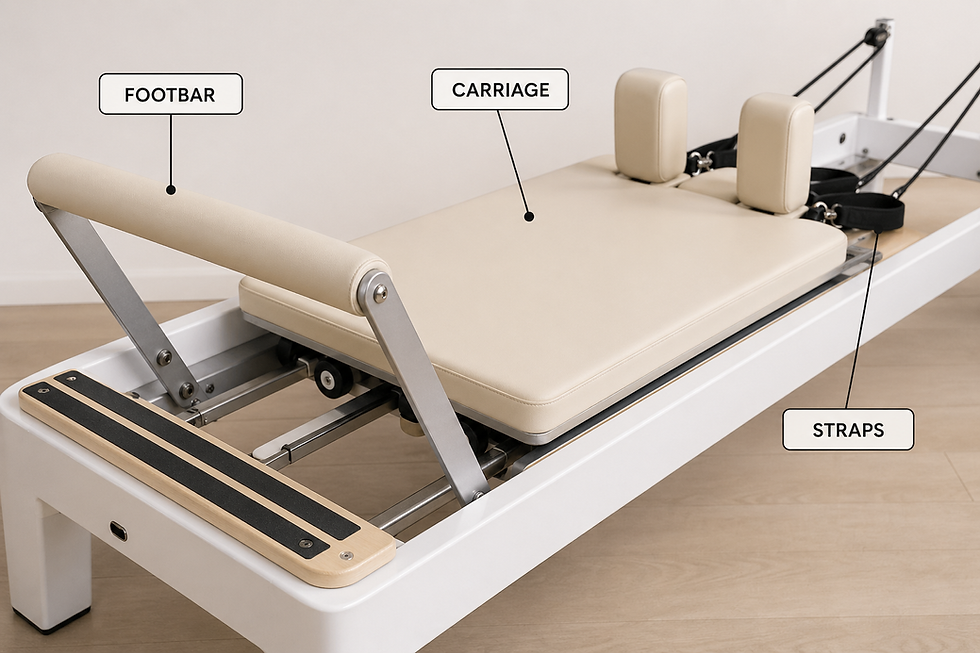
Confused by what’s in a Pilates studio? Here’s every piece of apparatus you might encounter - and what it does.
Cadillac / Trapeze Table: A large, bed-like frame with an overhead canopy from which springs, bars, a trapeze, and leg and arm springs are suspended. One of the most versatile pieces of Pilates apparatus in existence - used for everything from gentle rehabilitation to advanced acrobatic work. If you see one, it’s a sign of a serious studio.
Foam Roller: A firm cylindrical prop used for myofascial release (self-massage of the fascia and muscles) and as an unstable surface that challenges balance and core stability in Mat exercises.
Half Barrel: See Step Barrel/Spine Corrector
Jumpboard: A padded vertical board that attaches to the foot end of the Reformer, allowing the client to jump from a supine position. Adds a low-impact cardio element to Reformer classes - the sensation of jumping without the joint load of landing on your feet.
Ladder Barrel: A barrel-shaped prop combined with a ladder structure. The curved surface supports deep backbends, hip flexor stretches, spinal articulation, and side-lying work. Particularly good for flexibility and posture.
Magic Circle / Pilates Ring: A flexible metal or rubber ring with padded handles. Adds light to moderate resistance to Mat and Reformer exercises targeting the inner thighs, arms, chest, and abdominals. Underrated and versatile.
Ped-O-Pull: A standing apparatus with a spring-loaded pole. Used to challenge core control, upright alignment, and shoulder stability in a standing position - less common than the Reformer or Chair, but a useful training tool.
Pilates Box: A prop placed on the Reformer carriage to elevate or position the torso or pelvis. Long Box (lengthwise) is used for prone work like Swan and Pulling Straps; Short Box (crosswise) is used for seated spinal work and is one of the more challenging series on the Reformer.
Reformer: The most widely recognised piece of Pilates apparatus. A sliding carriage mounted on a frame, attached to springs of varying resistance via a gear system. Includes a footbar, shoulder blocks, and long straps with handles or foot loops. The Reformer enables a full-body Pilates practice in lying, sitting, kneeling, and standing positions - the spring resistance both assists and challenges movement depending on the exercise.
Resistance Bands: Elastic bands used in Mat and equipment classes to add resistance or support. Available in different tensions - lighter bands assist, heavier bands challenge.
Spine Corrector / Step Barrel: Smaller, more portable versions of the barrel. The curved surface opens the chest and anterior body in extension while supporting the spine. Used in both mat and apparatus classes.
Stability Ball / Overball: Large inflatable balls (Stability Balls) or smaller, squishier versions (Overballs) used to add instability - challenging the core to work harder to maintain position. Also used as supportive props in certain exercises.
Toe Corrector / Foot Corrector: Small spring-based tools designed to strengthen the toes, arches, and ankle stability. Less glamorous than the Reformer, but highly effective for anyone with foot issues, flat arches, or postural imbalances that begin at the ground.
Tower: A frame attached to a wall or Reformer, with spring attachments at various heights. Used for pushing, pulling, and stretching exercises that develop strength, flexibility, and alignment from a standing or lying position.
Wunda Chair: A compact, box-shaped piece of apparatus with a spring-loaded pedal and side handles. Deceptively simple in appearance, the Wunda Chair offers one of the most demanding stability and strength challenges in the Pilates method - because, unlike the Reformer, it offers almost no passive support. You create your own stability against the spring resistance.
The Six Core Principles of Pilates
Joseph Pilates believed that true physical health required not just a strong body but a disciplined, aware, and harmonious mind. These six principles underpin every exercise in the method:
Breathing: Deep, intentional, lateral breath powers movement and maintains core engagement simultaneously. The breath is never an afterthought in Pilates - it’s the engine.
Centering: All movement initiates from the Powerhouse - your deep core. Finding your centre before you move anything else is the foundation of the entire method.
Concentration: Total mental presence is required. Pilates cannot be done on autopilot. The focus you bring to each exercise is what transforms it from movement into practice.
Control: Contrology - the original name of the method - says it all. Every movement is guided by muscular intention, not momentum. Slow, deliberate, purposeful.
Precision: One movement done correctly is worth ten done carelessly. Precision builds the neuromuscular connections that create lasting change in the body.
Flow: Exercises connect seamlessly, one into the next. Movement is continuous, graceful, and efficient - a moving meditation rather than a series of disconnected drills.
Classical vs Contemporary Pilates: What’s the Difference?
You may hear both terms and wonder which one Rise is. The honest answer is: both, intentionally.
Classical Pilates
Stays faithful to the original exercises, sequences, and apparatus designed by Joseph Pilates. Classical training emphasises learning the full repertoire in its intended order, with the belief that the system works precisely because of how it’s structured. Terminology like ‘Contrology,’ ‘Stomach Massage,’ and ‘Spine Stretch Forward’ are classical in origin. Classical teachers often train in long apprenticeships with lineage instructors who trace their training directly back to Pilates’ original New York studio.
Contemporary Pilates
Integrates the original method with modern exercise science, biomechanics, and rehabilitation principles. Contemporary Pilates may use updated equipment, anatomical rather than imagistic cueing, and creative variations that respond to what we now know about how the body moves and adapts. Training programmes like APPI (the Australian Physiotherapy and Pilates Institute - the training our founder completed) sit in this tradition: evidence-based, anatomically grounded, and informed by physiotherapy research.
Neither is better. They are different lenses on the same method.
At Rise, we honour the roots of Pilates - the principles, the apparatus, the understanding that the system Joseph Pilates designed was genuinely brilliant - while teaching in a way that’s informed by current science and accessible to real bodies in real life. You get the depth of the classical tradition and the clarity of the contemporary approach.
A Note on Pilates Cues: Why They Sound the Way They Do
If you’ve ever been told to ‘breathe into your back,’ ‘grow tall through the crown of your head,’ or ‘imagine a string lifting your sternum,’ and wondered whether your instructor has briefly become a poet - there’s a reason for it.
Pilates cueing is deliberately imagery-based because imagery bypasses the analytical brain and speaks directly to the body. When you try to consciously engage a specific muscle, the movement often becomes effortful and mechanical. When you imagine a string lifting you, or water pouring down your spine, the body tends to find the position more organically and more accurately.
This is not fluff. It’s applied neuroscience dressed in beautiful language. The next time a cue sounds poetic, let yourself follow it literally - your body will usually know exactly what to do.
Your Pilates Vocabulary Grows With Your Practice
Knowing your Pilates vocabulary is more than just sounding savvy in class. It helps you move better, understand your body, and feel confident in your own practice. You won’t need to memorise this glossary before your first class. The language of Pilates reveals itself gradually, term by term, as the movements become familiar and the cues start to land in your body rather than just your brain. That’s exactly how it’s supposed to work.
Whether you're on the Mat or the Reformer, in Classical or Contemporary class, the language of Pilates is part of the method - and part of the magic.
Bookmark this page and come back to it when a term confuses you, when you want to go deeper into a principle, or when you’re curious about a piece of equipment. It’ll be here.
And if you ever want a human to explain something in person - Rise Pilates Studio is at 9 & 9a The Square, Keyworth, Nottinghamshire. Our instructors genuinely love this stuff. Bring your questions.
Browse our timetable and book a class here. Free parking on Bunny Lane.


Comments